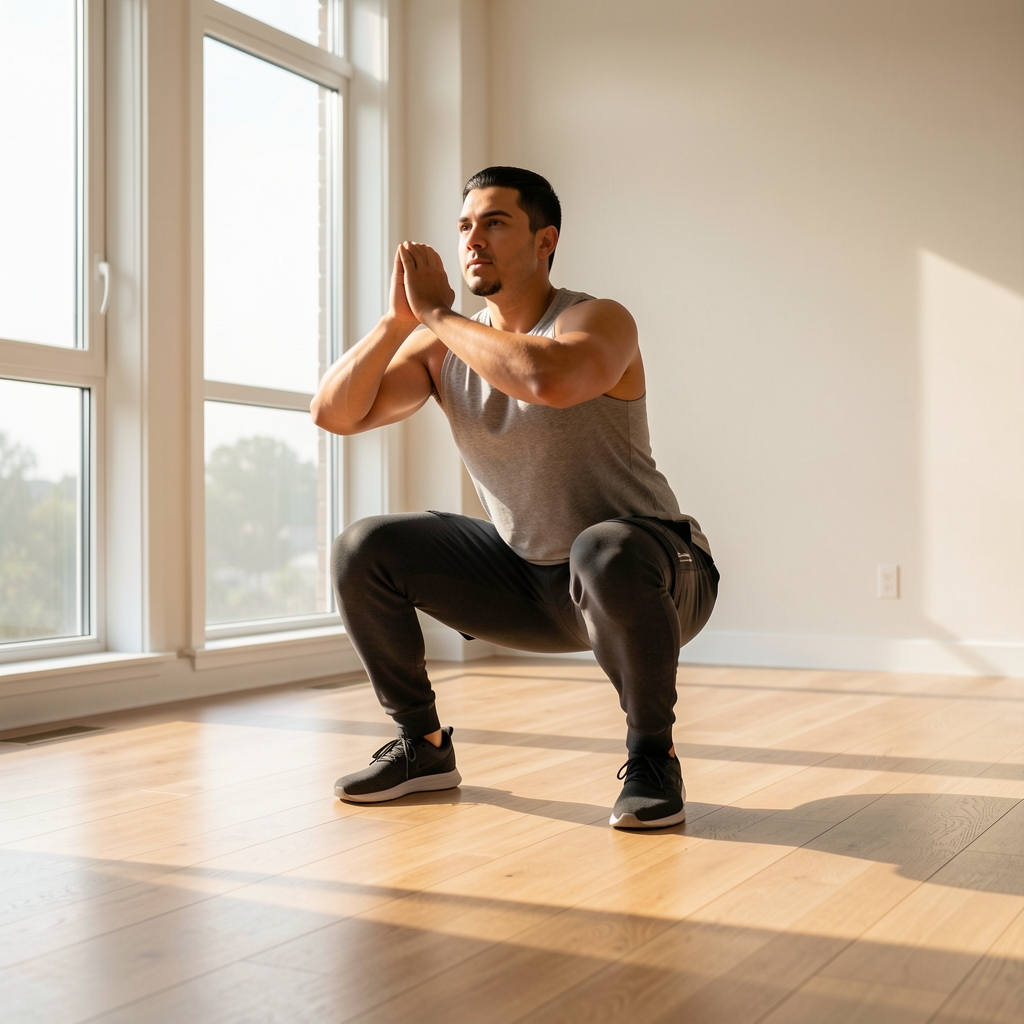
DAILY TRAINING RECORD
A structured archive of home workout routines, bodyweight protocols, and daily movement habits — compiled for those who train with consistency and intention.
Training Categories
HIIT At Home
Interval-based sessions structured for home cardio output. Each protocol documents work-to-rest ratios, movement sequencing, and progression notes for iterative endurance development.

Bodyweight Structure
Progressive loading through movement leverage, tempo variation, and unilateral patterns — no external load required.
Core Strength Training
Anti-rotation, bracing, and plantar sequences. Structured for desk workers addressing postural correction and spinal stability.
Flexibility & Mobility
Joint range, fascial lengthening, and active stretch sequences. Recovery and stretching integrated into structured daily sessions.
Resistance Band Workouts
Variable tension loading for upper body, lower body, and accessory movement patterns. Minimal kit, documented output.
The Case For Home Training
The trajectory of home training as a serious modality shifted significantly in recent years. What was once considered a compromise has been observed, through documented session tracking and consistency metrics, to produce equivalent functional outcomes when protocols are designed with structural rigour. Granelon compiles and contextualises this evidence into accessible, sessionised formats.
The study of movement quality — particularly the interaction between postural alignment, breath mechanics, and tempo-controlled repetition — sits at the centre of the Granelon approach. Each movement category in the archive is assigned a reference number, a progression tier, and documented rest-to-work parameters. This is not anecdotal guidance. It is structured movement documentation.
For individuals who exercise from a home environment — whether through schedule constraint, geographic access, or preference — the absence of equipment is not a limiting variable when the session architecture is correctly built. Bodyweight exercises, resistance band workouts, and home cardio sessions documented within the Granelon archive are constructed on the same progressive overload principles as facility-based training.
"Movement quality is a function of session design, not square footage."
Morning Exercise Habits
The longitudinal record of consistent practitioners demonstrates that session timing, particularly morning movement practice, correlates with sustained workout consistency across a twelve-month period. Granelon's morning protocol library addresses the practical constraints of early-session training — shorter warm-up windows, lower ambient temperature, and fasted-state movement.
Each morning protocol is structured into three phases: joint mobilisation (6–8 minutes), primary movement block (15–25 minutes), and a documented active recovery window. Sessions are designed to function within a 30–40 minute total window, without external equipment, in a standard domestic space.

Exercise for Desk Workers
Postural Correction
Protocols targeting the anterior chain shortening and thoracic rounding associated with extended seated periods. Documented movement sequences addressing shoulder retraction, hip flexor lengthening, and cervical positioning.
Breath & Bracing
Intra-abdominal pressure management through structured breath patterns. Integrated into all core strength training sequences to develop functional bracing capacity for daily movement demands.
Active Lifestyle Integration
Session segmentation for office-based individuals: structured movement breaks, micro-session templates (5–10 minutes), and daily movement practice habits that accumulate within a working schedule.
Field Notes
The session archive structure was the part I hadn't found elsewhere. Knowing each protocol has a reference number and a documented progression tier made it easier to track where I was in the system.
The morning exercise habits section changed my relationship with early sessions entirely. The three-phase structure removed the cognitive load of deciding what to do — the session starts and the archive tells you exactly where you are.
Frequently Asked
Common questions about the Granelon archive, session structure, and home training methodology.
Ask a questionThe core archive is structured entirely around no equipment workout formats. Bodyweight exercises form the primary movement library. Optional resistance band workouts are documented as a secondary protocol layer, requiring only a standard loop or tube band. No weights, machines, or benches are referenced in the foundational programmes.
Each workout planning template includes a session reference number, a movement category classification, a documented work-to-rest ratio, and a progression tier indicator. Templates are organised by training goal (strength building at home, endurance baseline, flexibility and mobility) and can be combined into weekly active lifestyle schedules using the planning index.
The beginner fitness guide within the archive operates on a tier-zero classification. Sessions at this level use lower movement complexity, extended rest intervals, and reduced session duration (20–25 minutes). Tier-zero protocols are specifically annotated for individuals re-establishing a daily movement practice after a period of reduced activity. Progression into tier-one is documented through a structured movement audit at the four-week mark.
Recovery and stretching protocols in the archive are classified separately from primary training sessions. The section includes passive static stretching sequences (hold durations: 30–60 seconds), active mobility flows (joint circles, controlled movement through range), and documented rest interval structures. These are assigned their own reference numbers and are recommended as daily practice independent of primary session days.
Workout consistency is approached through a session-logging framework. Each protocol carries a log field for date, tier, and subjective effort note. The archive's methodology section covers the four-week movement audit process, which uses accumulated log data to identify pattern gaps and inform progression decisions. Consistency is treated as a system output, not a personal quality — when the architecture is clear, the session record follows.
Home cardio sessions documented in the archive are structured around elevation of heart rate through movement sequencing rather than machine output. HIIT training at home formats, plyometric bodyweight series, and steady-state movement circuits are included. Published research on interval-based home cardio indicates comparable aerobic adaptation to facility-based protocols when session intensity and duration targets are met consistently.
The Archive Is Open
Browse the complete Granelon programme library or get in contact to discuss a structured home training approach suited to your schedule.